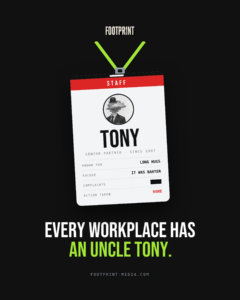
Every Workplace Has an Uncle Tony
He’s not a legend. He’s a liability with a lanyard. And he’s still here because somebody keeps letting him stay.
You know Tony.
You might not know your Tony yet, especially if you’ve just started somewhere new. But give it a week. Someone will lean over by the kettle, lower their voice, and say: “Just a heads-up about Tony…”
Tony has been here longer than the carpet. He remembers when the office had a smoking room, and he talks about it like a lost golden age. He has a mug that says World’s Best Boss, and nobody can remember buying it for him.
He calls the receptionist “darling,” the trainee “sweetheart,” and the HR manager “love.” He believes this makes him warm and approachable. HR has a folder that suggests otherwise.
Tony is a hugger. A Tony hug has a beginning, a middle and an uncomfortable epilogue. His hand finds the small of your back when he’s explaining something you already know. He leans over your desk to look at a screen he could see perfectly well from his own chair.
He’s funny too, just ask him. His jokes open with “I’m probably not allowed to say this anymore, but…” Then, tragically, he says it anyway.
He has a different name in every building: Tony, Gary, Steve, Malcolm, or “the Director, but he’s harmless really.” But he’s the same man, and every institution seems to have one.
Tony’s greatest hits
Every Tony has a back catalogue, and the tracks are remarkably consistent from office to office:
- The Lingering Hello. A hand on the shoulder that stays long enough to become a conversation of its own.
- The Compliment. “You look nice today. Big date tonight?” Said to a 23-year-old on her second day, in front of her new team.
- The Squeeze Past. Brushing past you in a corridor wide enough to park a van in.
- The Christmas Party. Legendary for all the wrong reasons, and the reason three women now leave before 9pm.
- The Defence. “It was a joke. Can nobody take a joke anymore?”
Tony insists he’s misunderstood. Strangely, he only ever seems to be misunderstood by young women, new starters and people too junior to push back.
The Tony Survival Guide
Tony’s real legacy isn’t his billings, his client list or his anecdotes about the 1990s.
It’s the survival guide.
Nobody ever wrote it down, and it’s never appeared in an induction pack, but every new starter receives it in their first week, usually whispered by the kettle or the lifts:
Don’t get in the lift with him on your own.
Don’t stay late if he’s still in.
Sit at the far end of the meeting table.
Laugh at the jokes, but not too much, or he’ll get ideas.
Wear a cardigan to the Christmas do.
And whatever you do, don’t complain.
Think about what that guide really is. It’s a safety manual written by junior staff because the people in charge wouldn’t write a disciplinary letter.
Somewhere in that building, a 22-year-old is planning her working day around one man’s hands, and she’s doing it because nobody senior has ever told him to stop.
That’s how you know Tony isn’t a secret. Tony is a tradition.
Tony doesn’t work alone
Here’s the part people prefer to skip.
Tony is never the only problem. A man like Tony can’t survive for twenty years on charm alone. He needs a support network, and he always has one.
It’s built from four words:
“Oh, that’s just Tony.”
It’s the manager who hears a complaint and moves the new girl’s desk instead of moving Tony. It’s the director who says “he’s old school, he doesn’t mean anything by it.” It’s the colleague who says “everyone knows what he’s like,” as if that makes it better rather than worse. And it’s the partner who quietly calculates that losing a junior is cheaper than losing Tony’s clients.
Every time someone says “that’s just Tony,” they confess two things at once:
- They already knew.
- They decided Tony was worth more than the people he made uncomfortable.
“He meant nothing by it” sounds like a defence, but it’s actually a verdict. So it’s fair to ask who reached it, on what evidence, and whether anyone listened to the person he touched first.
Here’s a simple test for any manager: would you handle it the same way if a 22-year-old trainee had done it to Tony?
If the answer is no, you don’t have a harassment policy. You have a seniority policy.
The people who pay for Tony
Tony has never paid a price for being Tony. Other people pay it for him.
The new starter who turns down the late meeting that would have got her noticed pays. So does the trainee who asks to move teams and gets labelled “difficult.” The talented junior who quietly hands in her notice pays too, and her exit interview mentions “culture” because she doesn’t trust anyone with the real reason.
New starters are the most exposed people in any workplace. They’re junior, eager to impress, unsure of the rules, and terrified of being the person who “made a fuss” in their first month.
They’re exactly who Tony picks, which makes them exactly who management should be protecting first.
Tony is not a “character”
Let’s retire a few excuses while we’re here.
“He’s from a different generation.” Plenty of men his age get through an entire working day without touching anyone. It’s really not that hard.
“It’s just his way.” So is being late, and you’d still have a word about that.
“She didn’t complain at the time.” Of course she didn’t. She’d read the survival guide.
“We don’t want to ruin his reputation over a misunderstanding.” Interesting. Nobody seemed worried about hers.
Tony isn’t quirky, eccentric or a lovable dinosaur. He’s a workplace hazard. If he were a loose floorboard, he’d have been fixed years ago.
In the UK, the law has caught up with Tony too. Since October 2024, employers have had a legal duty to take reasonable steps to prevent sexual harassment, not just respond to it after the fact. “Everyone knew what he was like” isn’t a defence any more. It’s evidence.
What retiring Tony actually looks like
Getting rid of a Tony culture isn’t complicated. It just requires someone to put the people being harassed ahead of the person doing it.
- Take the report seriously from the very first conversation. That means “thank you for telling me,” not “are you sure?”
- Investigate properly. Talk to witnesses, check the record, and ask whether this has happened before. If people “always knew,” there’s a trail.
- Move Tony, not the new starter. If someone has to change desks, teams or shifts, it should never be the person who spoke up.
- Protect against retaliation. Lost opportunities, sudden “attitude” comments or a frosty atmosphere all count. Watch for them.
- Follow up. Did it actually stop? Ask again in three months, not three years.
- Bin the survival guide. If junior staff are still warning each other, the problem hasn’t been fixed.
Confidentiality and fairness matter, for everyone involved, including Tony. But neither should become a reason to leave someone facing the same hands on Monday morning.
The footprint Tony leaves behind
Tony thinks his legacy is his anecdotes, his client list and his twenty-five years of service.
It isn’t. His legacy is the women who left, the careers that stalled, the complaints that went nowhere and the survival guide passed from one new starter to the next.
Management leaves a footprint too: every decision made after someone found the courage to speak up, and every decision they chose not to make.
Every workplace has a Tony only for as long as somebody lets him stay.
Every action leaves a footprint. Tony’s are all over the building.
If this is happening to you
You don’t have to put up with it, and you don’t have to work it out alone.
- Acas gives free, confidential workplace advice: 0300 123 1100, or visit acas.org.uk
- Citizens Advice can help you understand your rights and options: citizensadvice.org.uk
- Keep a record of what happened, when, and who saw it. Dates, messages and emails all help.
Does your workplace have a Tony? Tell us in confidence at footprint-media.com/tell-us-a-story. We read everything, and we protect our sources.
Tony is a fictional composite. Any resemblance to a real Tony is, frankly, the whole problem.